In fig. 3 presents KBIA as a system of interacting IAs.
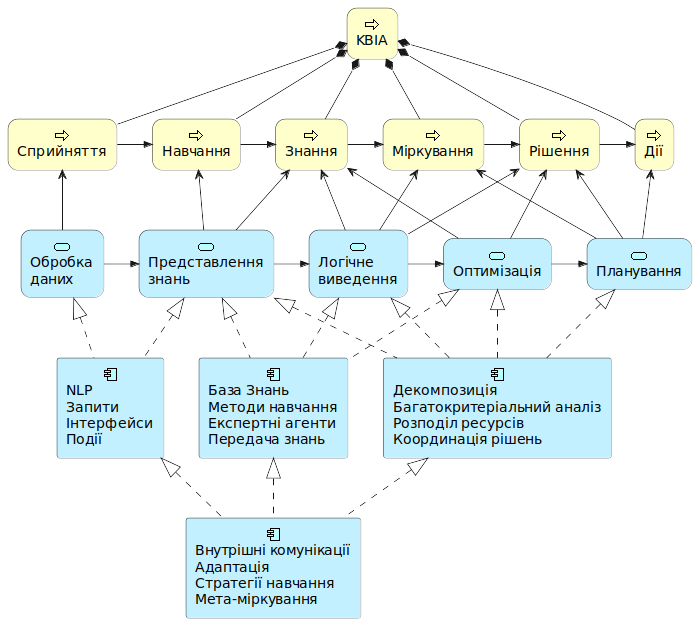
2.1.1 Characteristic properties of the KBIA model as a system of agents.
- Hierarchical structure. A KBIA can be modeled as a system of agents, where higher-level IAs monitor, orchestrate, and coordinate the activities of lower-level IAs. This hierarchical structure allows for modularity and specialization, where each IA focuses on specific subtasks.
- Specialized agents. In the KBIA system, individual IAs can be designed to perform special tasks, such as data preprocessing, feature extraction, reasoning, learning, or interaction with external systems.
- Multi-agent systems. KBIA systems can be built as multi-agent systems where different IAs interact with each other to achieve common goals. Each IA can have its own goals and capabilities.
- Distributed processing. The system workload can be distributed among different IAs, which enables parallel processing and efficient use of resources.
- Dynamic placement. Depending on task requirements, KBIA can dynamically distribute tasks among different IAs, adapting to changing conditions and resource availability.
- Communication and coordination. Agents in the KBIA system communicate with each other to exchange information, share successes and failures to coordinate their actions.
- Flexibility and scalability. The KBIA system can be flexible and scalable, allowing specialized IAs to be added or removed as needed.
- Hybrid approaches. KBIA as a system can combine different types of IA to take advantage of their complementary advantages.
Thus, the KBIA model can be represented as a composition of different IAs, each of which contributes to the overall problem-solving and decision-making process. This modular approach provides flexibility, specialization, collaboration and efficient use of resources, making KBIA systems capable of solving complex problems in a variety of subject areas.
2.1.2 Specialization of agents.
In the KBIA system, specialized agents are assigned to perform specific tasks, components, or aspects of the problem-solving process. These agents cooperate in the system to contribute and collectively achieve the goals of the system.
The data preprocessing agent is responsible for cleaning, transforming, and normalizing raw data before using it for analysis. It performs tasks such as cleaning data, extracting features and relationships.
A KR agent focuses on the representation of domain knowledge in structured formats such as ontologies, semantic networks or knowledge graphs, ensuring the organization and accessibility of the knowledge base.
A reasoning agent performs various forms of logical reasoning, including deductive, inductive, abductive, and analogical reasoning. It draws conclusions from existing knowledge and supports decision-making.
A learning agent is responsible for extracting knowledge from data through supervised or unsupervised learning, adapting new knowledge based on RL.
A planning agent creates sequences of actions and scenarios that ensure the achievement of specific goals, develops plans taking into account available resources, constraints and potential outcomes.
The communication agent provides communication and cooperation between different IAs in the system, exchanges information and supports the necessary internal protocols.
The interface agent manages the interaction between the KBIA system and users or external systems, handles data input/output and user requests, supports communication protocols and interfaces.
An optimization agent specializes in optimization techniques for finding optimal solutions in resource-constrained environments.
A learning strategy agent is responsible for meta-learning, which involves learning how to learn, adapting the learning strategies of other agents based on the characteristics of new tasks.
An expert agent embodies expertise in a particular subject area, providing specialized insights and knowledge related to that area.
An adaptation agent monitors system performance and adapts the behavior of other agents in response to changing conditions and requirements.
A meta-reasoning agent monitors and coordinates the reasoning processes of other agents, making decisions based on the context of the task about when and which reasoning strategy to use.
A decision-making agent specializes in making complex decisions, considering multiple criteria, trade-offs, and uncertainties to make the optimal choice.
A knowledge transfer agent transfers knowledge between different tasks and subject areas, allowing the system to use previous experience for new tasks.
These classes of specialized agents can be combined in various ways to create models of KBIA systems that will be suitable for problem solving, decision making, and knowledge management in a specific subject area. Each agent will contribute its unique strengths and capabilities to improve the overall performance of the system.